1 Neuropsychology Lab, Department of Psychology, School of Medicine and Health Sciences, Carl von Ossietzky Universität Oldenburg, Oldenburg, Germany ·
2 Cluster of Excellence “Hearing4All”, Carl von Ossietzky Universität Oldenburg, Oldenburg, Germany ·
3 Fraunhofer Institute of Digital Media Technology, Oldenburg Branch for Hearing, Oldenburg, Germany ·
4 Center for Neurosensory Science and Systems, Carl von Ossietzky University of Oldenburg, Oldenburg, Germany ·
5 Kiel University, Kiel, Germany
* Corresponding author | Experimental Brain Research 244, article 153 (2026) · Published 7 July 2026 · Peer reviewed · Open access
✓Published, peer-reviewed, and open access. This page accompanies the final article in Experimental Brain Research. The data supporting the findings are available on request from the corresponding author.
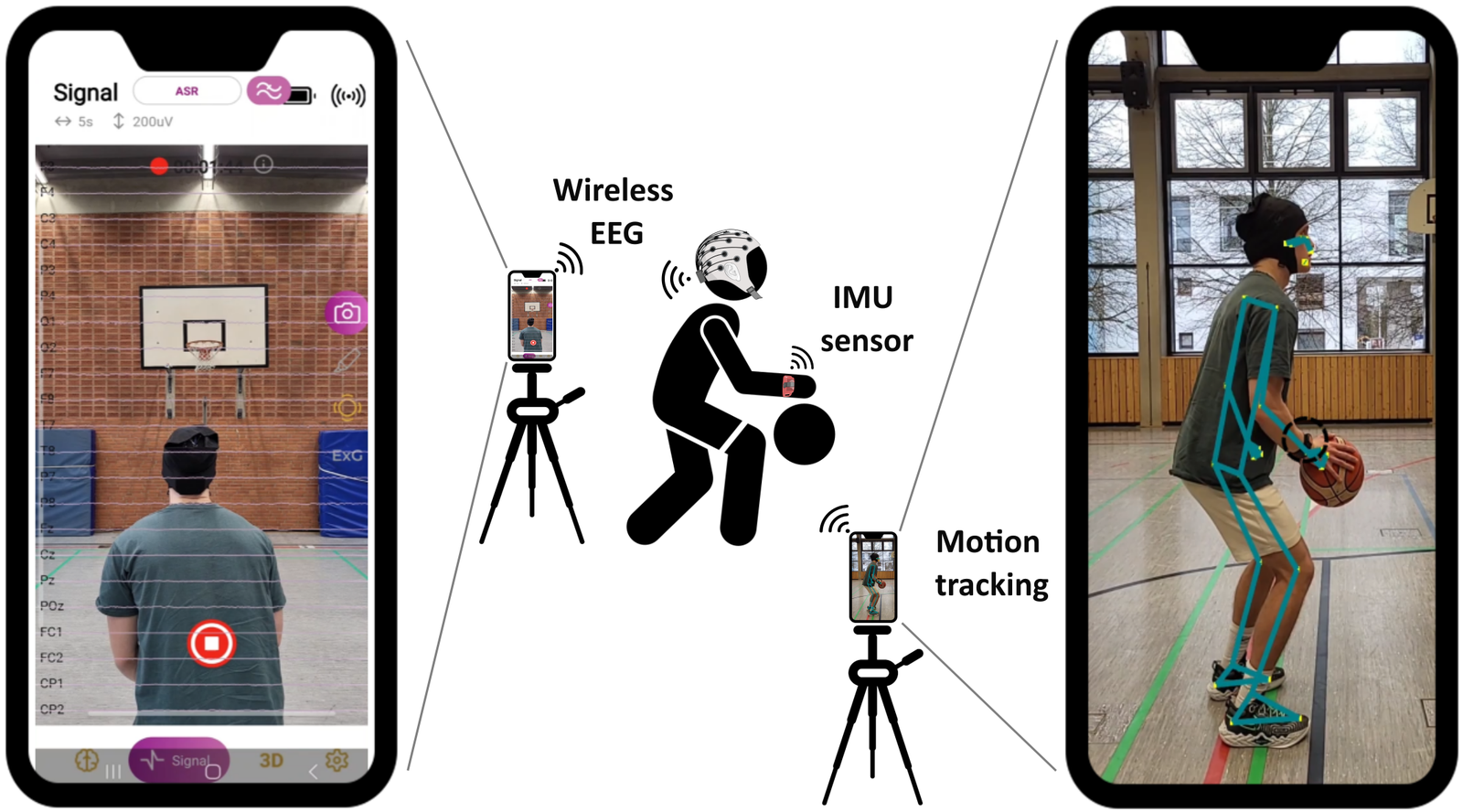
Synchronized mobile brain/body imaging (MoBI): smartphone-based pose tracking alongside wireless EEG during a basketball free-throw. Brain activity and whole-body movement are captured together, outside the laboratory.
Abstract
Advances in wireless electroencephalography (EEG) technology promise to record brain-electrical activity in everyday situations. To better understand the relationship between brain activity and natural behavior, it is necessary to monitor human movement patterns. Here, we present a pocketable setup consisting of two smartphones to simultaneously capture human posture and EEG signals.
We asked 26 basketball players to shoot 120 free throws each. First, we investigated whether our setup allows us to capture the readiness potential (RP) that precedes voluntary actions. Second, we investigated whether the RP differs between successful and unsuccessful free-throw attempts. The results confirmed the presence of the RP over fronto-central channels, with significant negative deflection at channel Cz, from −400 to 0 ms before movement onset (M ± SE: −6.54 ± 2.26 to −13.52 ± 2.42 µV; z = −2.53 to −3.92; FDR-corrected p = 0.049 to 0.003; r = 0.50 to 0.77). However, the amplitude of the RP was not related to shooting success (all FDR-corrected p > 0.05; maximum mean R2 = 0.047, i.e., 4.7% explained variance). Preliminary exploratory pose analysis conducted offline indicated the presence of participant-specific variations in posture between successful and unsuccessful shots in 38.5% of participants (10/26), with 4.5% explained variance (maximum mean landmark R2 = 0.045).
We conclude that a highly portable, low-cost and lightweight acquisition setup, consisting of two smartphones and a head-mounted wireless EEG amplifier, is sufficient to monitor complex human movement patterns and associated brain dynamics outside the laboratory.
mobile EEGhuman posereadiness potentialMoBIbasketball
The pocketable setup
Everything needed to record synchronized brain activity and movement fits in a backpack.
Fig. 1. Pocketable setup for basketball free-throw shooting. Two tripods are used to keep two Android smartphones in fixed positions. One smartphone wirelessly receives EEG data recorded along with video recordings from the same phone (Smarting Pro app). The second smartphone captures human motion in real-time (MediaPipe Pose Landmark Detection app). A single Movella DOT sensor placed at the right wrist streams IMU signals. LSL SENDA and LSL RECORDA Android apps manage time-synchronous acquisition of all sensor streams.
Two smartphones, one synchronized stream
Instead of a dedicated lab, the recording relies on consumer hardware and open tooling, time-aligned through the Lab Streaming Layer.
Wireless EEG from a head-mounted amplifier (Smarting Pro), received and recorded on a smartphone.
Markerless pose tracking via a second smartphone running MediaPipe Pose Landmark Detection.
Wrist IMU (Movella DOT) providing acceleration to pinpoint movement onset.
Time-synchronous acquisition of all sensor streams using LSL SENDA/RECORDA — sharing a common clock.
Synchronized acquisition with LSL
Three sensor streams — EEG, body pose and wrist IMU — captured across two phones and the
NeuropsyOL apps, consolidated into one synchronized recording.
🧠
Wireless EEG Phone 1Smarting Pro app (mBrainTrain) → EEG & video → LSL
Streaming is distributed across two smartphones (EEG and pose) plus the wrist IMU, while recording is
consolidated by RECORDA over a shared local network. All streams carry a common LSL clock and synchronized timestamps. Acquisition uses the open-source
RECORDA & SENDA Android apps from the Neuropsychology Lab Oldenburg.
Grand-average readiness potential
A clear pre-movement negativity emerges over central electrodes — captured entirely with a portable, smartphone-based setup.
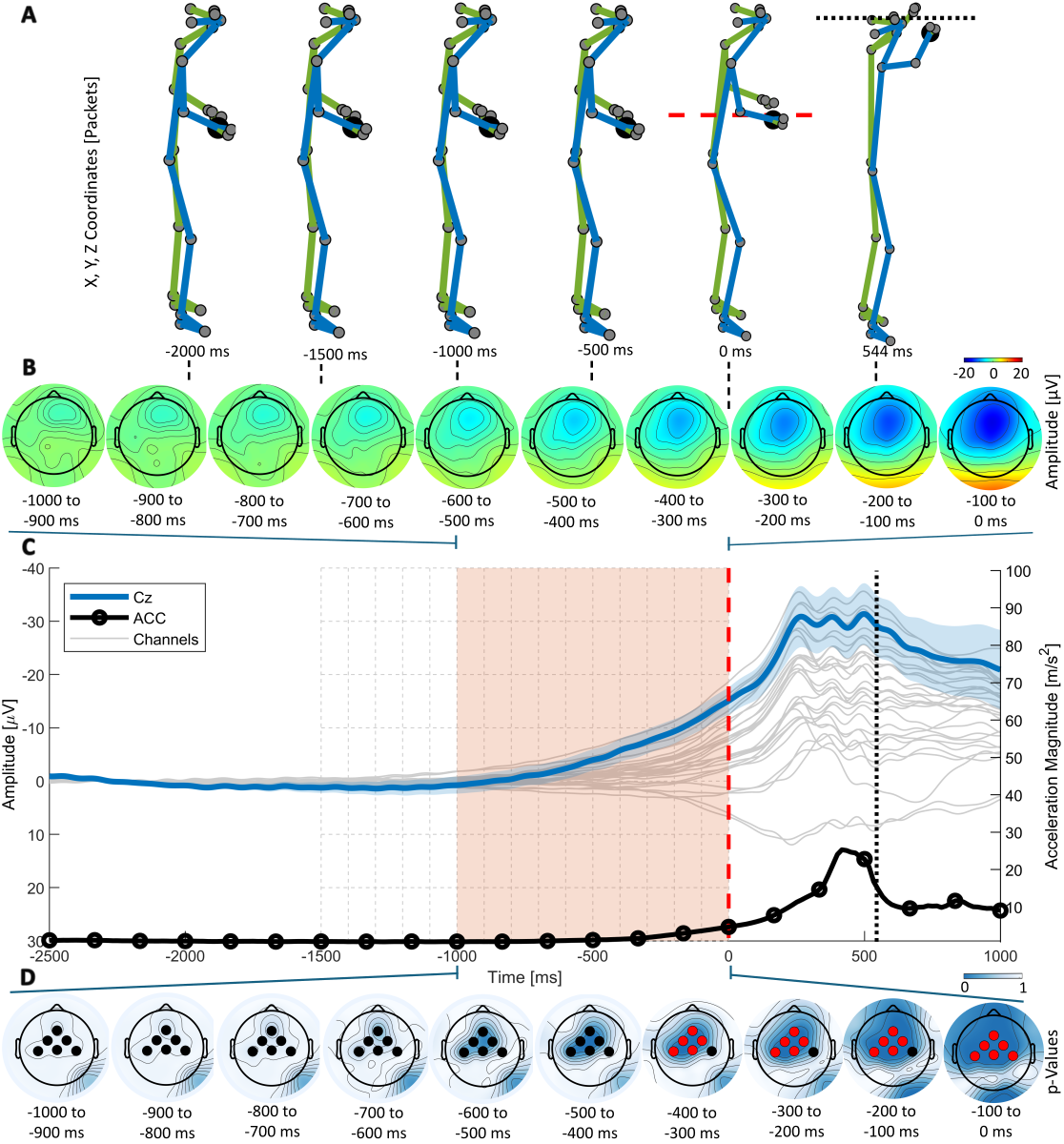
Fig. 3. Grand average of simultaneous human motion capture and ERP. Mobile EEG, motion patterns, and sensor IMU signals were combined to analyze the readiness potential (RP) and motor activity during task execution. A Motion tracking of body postures at key time intervals relative to movement onset. B Grand average ERP topographies at time intervals show the spatiotemporal evolution of the RP, with increased negativity over (fronto-) central channel sites leading up to movement onset. C RP evolution: The RP (blue line, channel Cz) exhibits a gradual negative deflection preceding movement onset (red dotted line). The onset of movement was determined using wrist accelerometer data (black circle-line). Time reference “set-point” is shown in black dot line. D ERP significance testing: Mean ERP amplitudes across 100 ms time bins were tested against zero. Topographical maps display significant regions (p < 0.05, red dots) after false discovery rate correction, indicating where the RP differed significantly from baseline.
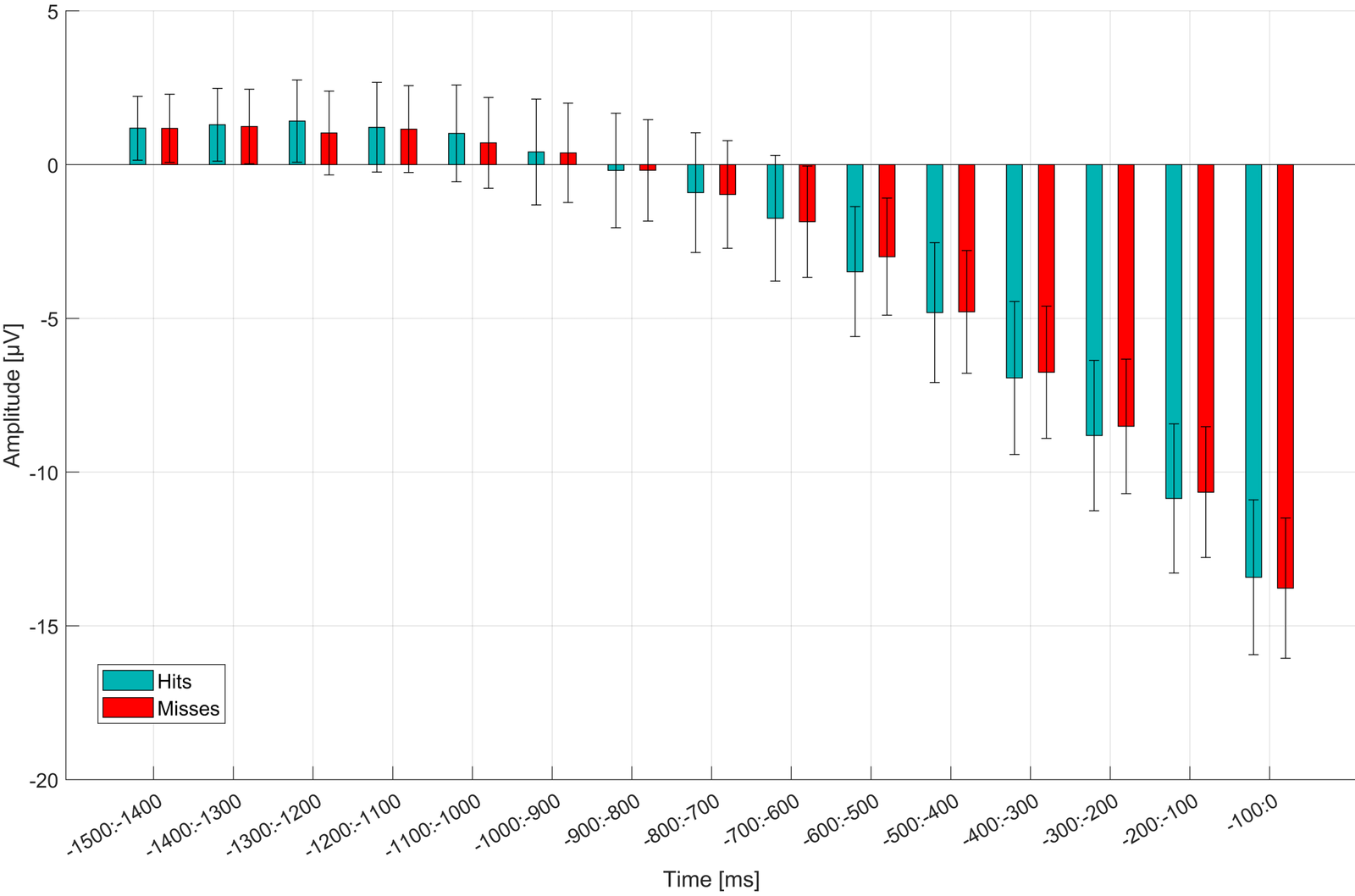
Fig. 4. Grand average ERP comparison between conditions across participants. The grand average amplitude of the ERP recorded from the Cz channel, comparing successful (hits) and unsuccessful (misses) basketball free-throw shots across all participants is shown. The RP amplitudes are presented in 100 ms bins from −1500 ms to 0 ms relative to movement onset. Blue bars represent hits, and red bars represent misses, with error bars indicating the standard error of the mean for each bin.
Videos
Smartphone recordings, synchronized MoBI reconstruction, grand-average animation, and the full YouTube playlist.
Smartphone recording. A single phone on a tripod captures the free-throw attempt while wirelessly recording EEG through the Smarting Pro app.
Experimental set-up. Simultaneous recording of wireless EEG and motion tracking during natural basketball free-throw shooting.
Synchronized MoBI reconstruction. Pose landmarks and the wireless EEG signal are shown together, illustrating the synchronized brain-body data acquired with the two-smartphone setup.
Grand-average animation. Dynamic visualization of group-averaged body posture, grand-average ERP scalp topographies across participants, participant-level Cz waveforms, the grand-average Cz readiness potential, and wrist-accelerometer magnitude across the free-throw movement. Full video motion and additional recordings are available on YouTube below.
@article{contrerasaltamirano2026portable,
  title   = {A portable solution for simultaneous human movement and mobile
             EEG acquisition: readiness potential for basketball free-throw shooting},
  author  = {Contreras-Altamirano, Miguel and Klapprott, Melanie and
             Jacobsen, Nadine and Maanen, Paul and Welzel, Julius and Debener, Stefan},
  journal = {Experimental Brain Research},
  year    = {2026},
  volume  = {244},
  number  = {8},
  pages   = {153},
  doi     = {10.1007/s00221-026-07342-6},
  url     = {https://doi.org/10.1007/s00221-026-07342-6}
}
Acknowledgements
Acknowledgements. We would like to thank the professional basketball club EWE Baskets Oldenburg for their cooperation and the Institute of Sports Science at the University of Oldenburg for making the data collection possible. We would also like to thank Reiner Emkes for his technical support.
Funding. Open Access funding enabled and organized by Projekt DEAL. The development of software tools used in this study was funded by the Deutsche Forschungsgemeinschaft (DFG, German Research Foundation) as part of the German Excellence Strategy—EXC 2177/1—Project ID 390895285. In addition, internal funds of the Neuropsychological Laboratory Oldenburg were available.